
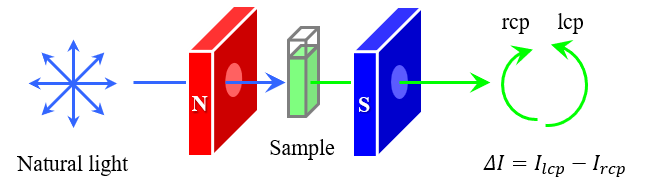
Figure 3 presents the optical system used in the JASCO CPL-300 spectrometer. This system utilizes a high-brightness xenon lamp that emits a continuous spectrum to cover a wide range of applications. The excitation light is first monochromated and then depolarized before reaching the sample. The sample compartment uses a 180° configuration to minimize the effects of artifacts. This also allows measurements of solids, such as films, powders, and KBr pellets, and enables magnetic circularly polarized luminescence (MCPL) measurements. The CPL signal emitted from the sample passes through a photoelastic modulator (PEM) and a polarizer, and is then monochromated on the emission side. A double-prism monochromator is employed on both the excitation and emission sides to eliminate stray light including higher-order diffraction and polarization artifacts introduced by the spectrometer. Detection is performed using a high-sensitivity photomultiplier tube and a lock-in amplifier to achieve a wide dynamic range, high-sensitivity detection, and reduced measurement time.

Fig. 3 Optical system for CPL-300
Related Posts:
 Analysis of electronic structure of phthalocyanine…
 Highly efficient spectral measurement methods using…
 Evaluation of aggregation-induced circularly…
 Evaluation of Circularly Polarized Organic Light…
 Avoiding Interference from Fluorescence Signal by…
 Determination of Absolute Configuration of Molecules…