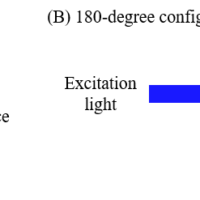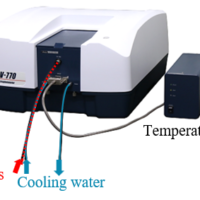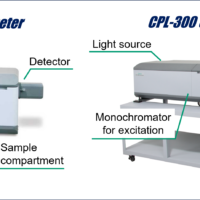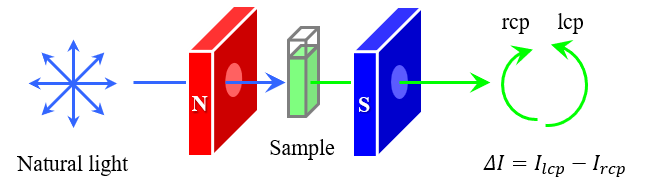
Circularly polarized luminescence (CPL) spectroscopy is an analytical technique that detects the difference in luminescence intensity between left-handed circularly polarized (LCP) and right-handed circularly polarized (RCP) light during optical excitation of a sample (Figure 1). Recent years have seen an increased amount of research on compounds exhibiting CPL properties, because such compounds are expected to find applications in next-generation display fields including 3D displays, life science fields such as optical sensing and bioimaging, and security fields including communication technology and anti-counterfeiting technology.
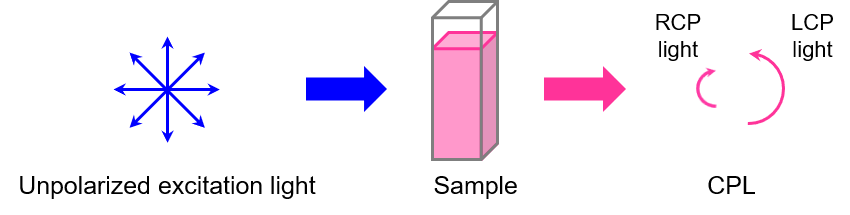
Fig. 1 Schematic diagram of CPL measurement
Generally, the CPL intensity is expressed using the luminescence dissymmetry factor (glum), which is defined by the following equation (Figure 2).

Here, IL and IR represent the luminescence intensities of LCP light and RCP light, respectively. Generally, glum is between −2 and 2, with −2 representing pure RCP light and +2 representing pure LCP light.
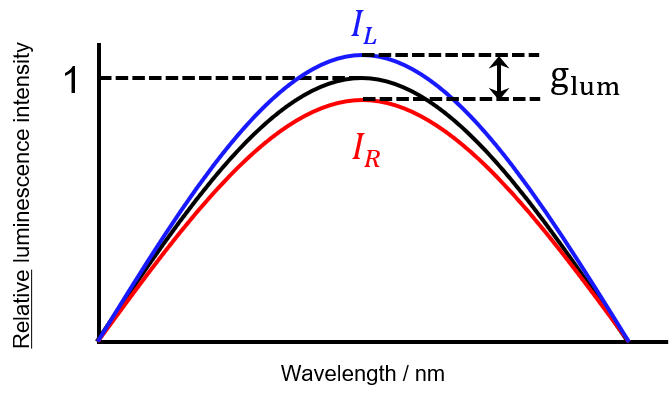
Fig. 2 Relative luminescence intensity for LCP (blue) and RCP (red) light, together with definition of glum