
In this section, the roles and principles of the general components of a typical CPL spectrometer including the CPL-300 are described.
1. Light Source
To detect CPL signals, which are generally very weak, a high-brightness light source is essential. For applications that require the excitation wavelength to be varied, a xenon lamp is commonly used. However, if a fixed excitation wavelength is sufficient, such as when measuring similar samples, or in customized systems, a single-wavelength laser may be used.
The CPL-300 employs a xenon light source to cover a wide range of applications.
2. Monochromators
A monochromator is a device that extracts monochromatic light from a light source. Prisms or diffraction gratings are commonly used as dispersive elements to obtain monochromatic light. Figures 4(a) and 4(b) show schematic diagrams of monochromators employing a prism and a diffraction grating, respectively. The dispersive element is rotated to extract light only at the required wavelength from the exit slit. CPL spectrometers feature two monochromators: one on the excitation side to isolate the excitation wavelength, and one on the emission side to select the desired fluorescence wavelength.
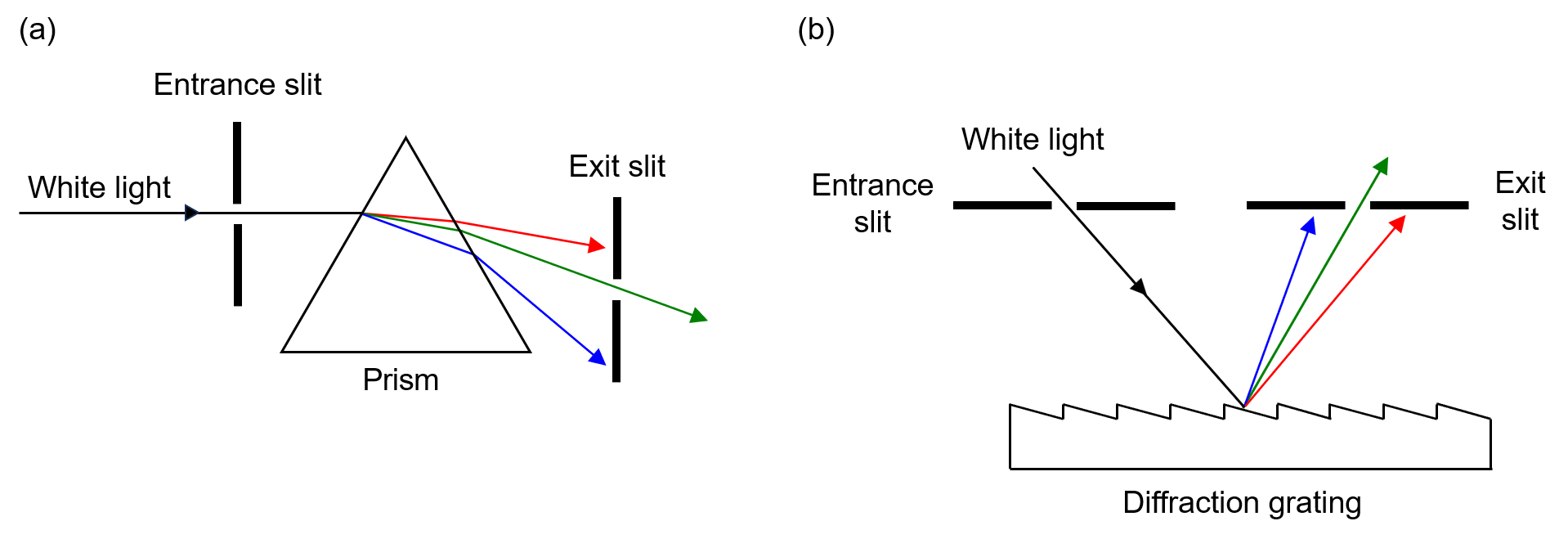
Fig. 4 Schematic diagrams of monochromators based on (a) prism, and (b) diffraction grating.
A prism, made from quartz or fused silica, disperses light based on the wavelength-dependence of its refractive index (Figure 5). A diffraction grating is composed of numerous parallel grooves, and disperses light by diffracting different wavelengths at different angles. Prisms maintain the original polarization state of the incoming light and do not produce higher-order diffraction. Diffraction gratings, on the other hand, are more cost-effective and suitable for mass production but require filters to suppress higher-order diffraction (Figure 6). Gratings also exhibit polarization-dependent behavior, which can affect polarization measurements (Figure 7). This is referred to as the Wood anomaly, a phenomenon where the diffraction efficiency changes suddenly at specific wavelengths, caused by the polarization characteristics of diffraction gratings. For these reasons, prisms are ideal for polarization-sensitive instruments such as circular dichroism (CD) and CPL spectrometers.
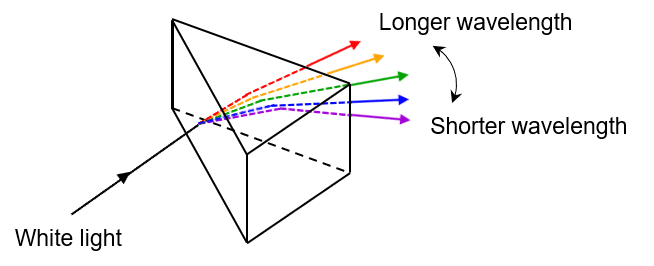
Fig. 5 Dispersion of light through a prism
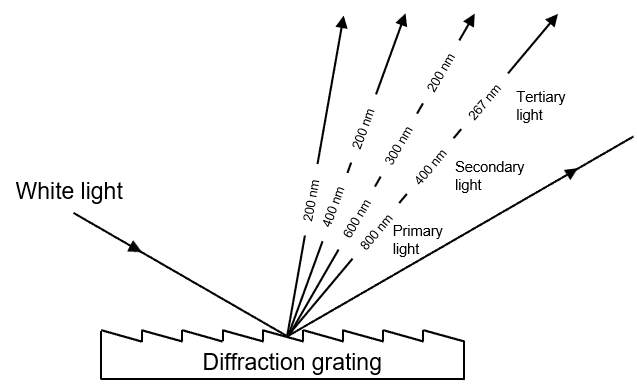
Fig. 6 Graphical diagram of higher-order diffraction
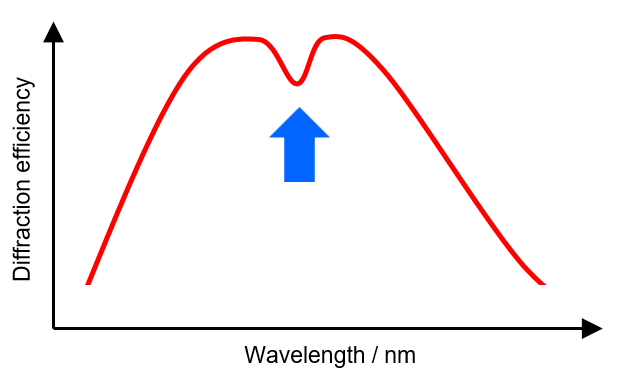
Fig. 7 Wood’s anomaly
Monochromators can be constructed using a single dispersive element or two dispersive elements (Figure. 8). Single monochromators yield high optical brightness, whereas double monochromators are effective at reducing stray light. In CD and CPL spectroscopy, extremely small differences between the intensities of LCP and RCP light must be detected. Therefore, extreme caution is required to reduce ghost peaks and spectral distortions, including those caused by stray light. Consequently, the use of a double monochromator system is critically important.
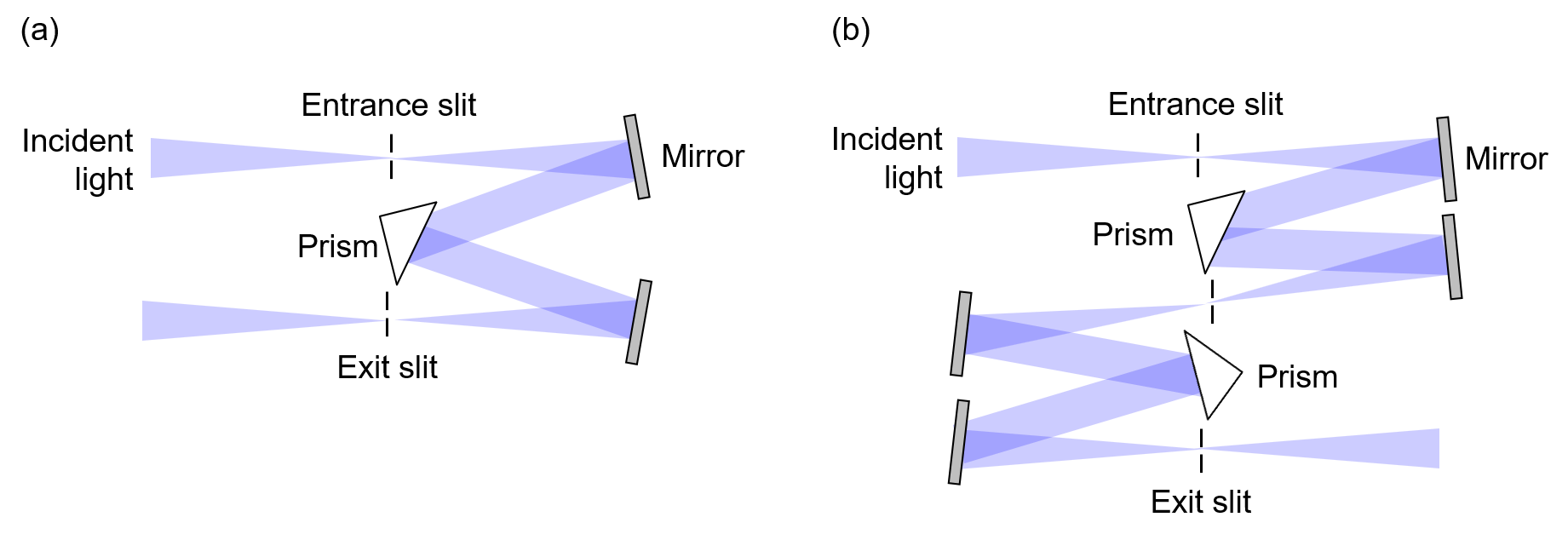
Fig. 8 Optical system for (a) single monochromator and (b) double monochromator
The CPL-300 employs a double-prism monochromator that greatly suppresses the effects of stray light, higher-order diffraction, and the polarization characteristics of the instrument.
Note: Instruments designed for limited applications with a predetermined excitation wavelength may use a bandpass filter to select the excitation wavelength; however, such a filter is not referred to as a monochromator.
Related Posts:
 Comparison of Separation Behavior among Silica-based…
 Development and Applications of Full-Vacuum FT-IR…
 Dependence of Degree of Crosslinking for Epoxy…
 ISO/IEC 17025-Certified Quartz Plate Calibration…
 Quartz Plate Calibration Accredited by ISO/IEC 17025
 Vibrational Circular Dichroism Spectrometer based on…