Introduction
Key Points
The use of quartz plates streamlines the accuracy inspection process for polarimeters
The use of quartz plates calibrated by an ISO/IEC 17025 accredited laboratory is compliant with the accuracy inspection defined by USP-NF 2024, Issue 3
Accuracy checking is crucial for reliable measurements using analytical instruments. The accuracy inspection is often performed by checking the deviation of the measured value from the known value. For polarimeters, sucrose solutions are widely used for accuracy inspection. However, solution samples present challenges when used as reference materials. For example, concentration errors may occur during their preparation, or expiration dates need to be considered. As a result, quartz plates are becoming popular for accuracy inspection since they do not need special preparation and are very stable.
Pharmacopoeias specify methods for inspecting the accuracy of optical rotation measurements, including the use of a quartz plate as a reference material (Table 1). In the U.S. pharmacopoeia (USP), reference materials must have an expanded uncertainty associated with a calibration performed by a national metrology institute that is signatory to the International Committee for Weights and Measures Mutual Recognition Arrangement (CIPM MRA) or an ISO/IEC 17025 accredited calibration laboratory where the accreditation body is a signatory to the International Laboratory Accreditation Cooperation Mutual Recognition Arrangement (ILAC MRA).1)
JASCO Corporation Calibration Division is accredited by ISO/IEC 17025 and provides a calibration value for quartz plates together with an expanded certainty, compliant with the accuracy inspection defined by USP-NF 2024, Issue 3. This report describes the quartz plate products and the calibration service that JASCO offers.
Table 1. Accuracy test in pharmacopoeias
| Pharmacopoeia | Description |
| U.S.Pharmacopeia (USP-NF 2024, Issue 3) | “Verify the accuracy of the polarimeter at the operating wavelength(s) by measuring a certified optical rotation reference material having an associated expanded uncertainty. Typically, quartz plate reference standards with certified optical rotation values are used. Alternatively, other suitable certified reference materials or reference standards may be used.”1) |
| European Pharmacopoeia (EP11.0) | “The accuracy of the scale is checked near the value to be measured or over an appropriate range, usually by means of certified quartz plates. Other certified reference materials may also be suitable (e.g sucrose solutions).”3) |
| Japanese Pharmacopoeia (JP18) | “Accuracy of the scale of the apparatus is verified by measuring the optical rotation of a solution of sucrose for optical rotation if the reading indicates the value of its known specific optical rotation. For daily verification an optical rotation known quartz plate may be used for this purpose.”2) |
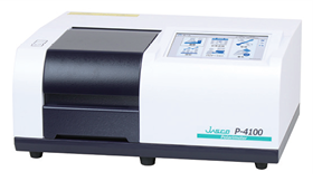
Fig. 1. P-4000 series polarimeter
Our Products and Service
Quartz Plates
JASCO offers four types of quartz plate with different optical rotations of +2°, -2°, +17°, and -17°. Use of a quartz plate whose optical rotation is closest to that for the customer’s sample is recommended. Some examples are given below.
Choosing -2° quartz plate for 50 mg/mL of ephedrine hydrochloride in water (1.0 dm)
Specific rotation [α]D25: -33.0° to -35.5° 1)
Optical rotation: -1.65° to -1.78° *
Choosing +17° quartz plate for 260 mg/mL of sucrose (1.0 dm)
Specific rotation [α]D20: +66.3° to +67.0° 1)
Optical rotation: +17.24° to +17.42° *
*The optical rotation was calculated from the specific rotation.
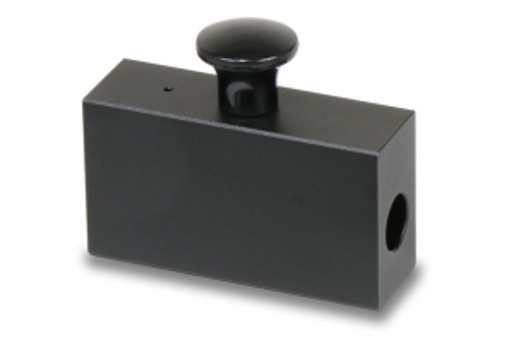
Fig. 2. Quartz plate
Calibration
JASCO Corporation Calibration Division offers a calibration service for the four types of quartz plate described above. A calibration certificate is provided with a calibration value and an expanded uncertainty obtained using the D-line emission from a sodium (Na) lamp.
Table 2. Calibration results shown in the certificate
| Item | Description |
| Optical rotation at 20 ºC / º | Calibration value for the corresponding quartz plate |
| Expanded uncertainty / º | 0.003 |
| Wavelength / nm | 589.44 D-line from Na lamp (in vacuum) |
| Light-source aperture / mm | ⌀2 |
| Sample compartment aperture / mm | ⌀8 |
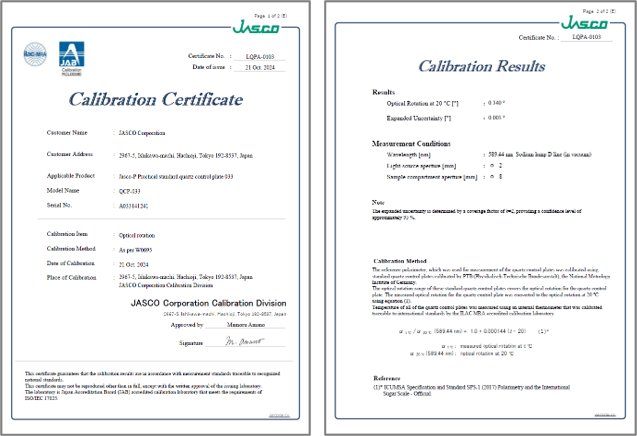
Fig. 3. Example of calibration certificate
Keywords
Polarimeter, quartz plate, instrument management, instrument maintenance, validation, accuracy test, U.S. pharmacopoeia (USP), European pharmacopoeia (EP), Japanese pharmacopoeia (JP), ISO/IEC 17025, calibration, expanded uncertainty
Conclusion
The use of quartz plates enables efficient accuracy tests for polarimeters. In addition, using quartz plates calibrated by an ISO/IEC 17025 accredited laboratory ensures that the accuracy test meets the requirements specified by USP-NF 2024, Issue 3.
The P-4000 series polarimeters have a validation function that provides instrument inspections compliant with USP, EP, and JP. Refer to the application note below for details about each inspection for validation.
References
1.United States Pharmacopeial Convention: “USP-NF 2024 Issue 3”, (2024).
2.Ministry of Health, Labour and Welfare: June 7, 2021, MHLW Ministerial Notification No. 220, “The Japanese Pharmacopoeia 18th edition”, (2021).
3.Council of Europe: “European Pharmacopoeia 11th edition”, (2023).